Walmart’s Strategic Repricing as a Tech-Services Compounder
Walmart is being repriced as a tech-services compounder as it expands into e-commerce, fintech, logistics, and digital platforms.
 Favour Oluoma Solomon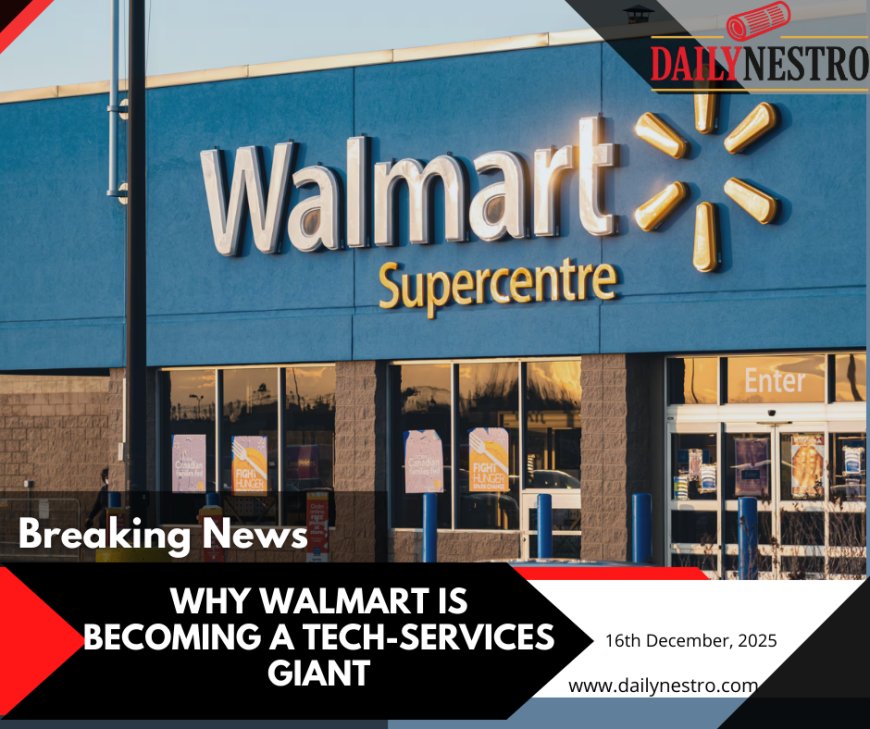
For decades, Walmart was viewed primarily as a low-margin retail giant built on scale, price leadership, and physical stores. Today, that perception is rapidly changing. Investors and analysts are increasingly repositioning Walmart as a technology-enabled services company, reflecting a broader transformation that integrates retail, digital infrastructure, financial services, and logistics into a unified ecosystem.
This strategic repositioning is not just cosmetic; it represents a fundamental shift in how Walmart generates value, competes globally, and positions itself for long-term growth.
From Retail Giant to Digital Platform
Walmart’s evolution mirrors a wider trend across legacy corporations: technology is no longer a support function; it is the business model.
While retail remains Walmart’s core revenue engine, the company has aggressively expanded into high-margin, tech-driven segments such as:
-
E-commerce and digital marketplaces
-
Payments and financial services
-
Advertising technology
-
Supply-chain and logistics platforms
-
Data and analytics-driven retail services
This diversification allows Walmart to monetize its massive customer base, physical footprint, and data assets far beyond traditional in-store sales.
As a result, investors are beginning to value Walmart not just as a retailer, but as a multi-layered services compounder a company capable of generating recurring, scalable revenue streams over time.
E-Commerce as the Foundation, Not the Endgame
Amazon's and Walmart's e-commerce campaigns are frequently contrasted, but their strategic reasoning is different.
Walmart integrates e-commerce into a larger omnichannel ecosystem, utilizing its physical stores as fulfillment centers rather than handling online retail as a standalone channel. This hybrid model enables:
-
Faster last-mile delivery
-
Lower logistics costs
-
Buy-online-pickup-in-store efficiency
-
Enhanced customer data collection
The end product is a digital retail business that feeds into and supports higher-margin services like payments, subscriptions, and advertising.
Payments, Fintech, and Embedded Finance
One of the most underappreciated elements of Walmart’s transformation is its financial services strategy.
By embedding payments, digital wallets, and financial products into its ecosystem, Walmart is positioning itself at the intersection of retail and fintech. This allows the company to:
-
Reduce transaction friction for customers
-
Capture payment data and behavioral insights
-
Generate fee-based revenue
-
Expand financial access in underbanked markets
For investors, this represents a shift away from purely transactional retail revenue toward platform-style economics, where each customer interaction deepens lifetime value.
Logistics as a Monetizable Technology Asset
Walmart’s logistics network, once seen purely as a cost center, is increasingly viewed as a strategic technology asset.
The company’s investments in automation, AI-driven inventory management, and predictive analytics have transformed its supply chain into a competitive advantage. More importantly, these capabilities are now being leveraged to:
-
Improve third-party marketplace fulfillment
-
Support same-day and next-day delivery
-
Enable scalable, service-based logistics offerings
This positions Walmart not only as a retailer but also as a logistics and infrastructure platform capable of supporting external sellers and partners.
Advertising and Data: The Margin Expansion Engine
Retail media has emerged as one of Walmart’s fastest-growing and highest-margin segments.
By monetizing customer data through targeted advertising, Walmart can generate revenue without holding inventory or absorbing logistics costs. Brands are willing to pay a premium to access Walmart’s massive, purchase-ready audience, especially as third-party cookies decline globally.
This shift is critical to Walmart’s repricing story:
-
Advertising revenue boosts operating margins
-
Data-driven insights strengthen supplier relationships
-
Platform economics improve return on capital
In essence, Walmart is converting foot traffic and digital engagement into a media business.
Why Investors Are Repricing Walmart
Traditionally, retail stocks trade at modest valuation multiples due to thin margins and economic sensitivity. Walmart’s transformation challenges that model.
Analysts now see Walmart as:
-
A defensive consumer brand
-
A technology-enabled platform
-
A services compounder with recurring revenue
-
A data-rich ecosystem with pricing power
This hybrid identity supports higher valuation expectations, especially as technology and services account for a growing share of operating income.
A Broader Signal for Legacy Brands
Walmart’s strategic repositioning reflects a broader global trend: legacy companies that successfully integrate technology are being rewarded by markets.
Rather than being disrupted, firms with scale, data, and infrastructure are finding ways to reinvent themselves as platforms, blurring the line between retail, tech, and services.
For investors, this underscores an important lesson: the future of technology investing may not lie solely in pure-play tech firms but in traditional leaders that evolve into tech-enabled ecosystems.
Walmart’s repricing is not about abandoning retail; it’s about redefining it.
By embedding technology, services, and data into every layer of its operations, Walmart is transforming from a low-margin retailer into a high-utility, multi-revenue platform. As markets continue to reassess what constitutes a “tech company,” Walmart’s evolution offers a powerful case study in how scale, innovation, and strategy can converge to create long-term shareholder value.