Samsung Unveils Industry’s First 2nm Mobile Chip: Exynos 2600 Signals a New Era for Smartphones
Samsung has unveiled the world’s first 2nm mobile chip, the Exynos 2600, redefining smartphone performance, battery efficiency, and on-device AI. Here’s why this semiconductor breakthrough could reshape the global tech race.
 Favour Oluoma Solomon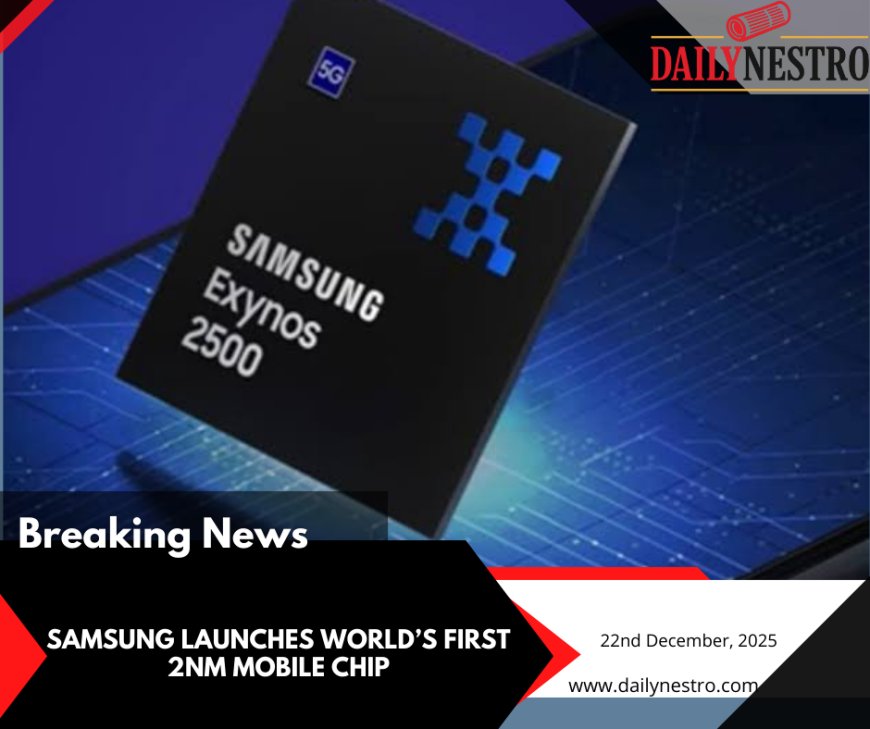
Samsung has officially unveiled the Exynos 2600, the world’s first mobile chipset manufactured using an advanced 2-nanometer (2 nm) process. The announcement marks a major milestone in semiconductor innovation and positions Samsung at the forefront of next-generation mobile computing.
By integrating the CPU, GPU, and Neural Processing Unit (NPU) into a single ultra-efficient chip, the Exynos 2600 promises significant improvements in performance, battery efficiency, and on-device artificial intelligence (AI). The launch is widely seen as a turning point not only for smartphones but also for the broader global chip industry.
Why the 2nm Breakthrough Matters
Chip manufacturing has long been defined by a race toward smaller, more efficient process nodes. Moving from 3 nm to 2 nm technology represents one of the most difficult and consequential leaps in semiconductor engineering.
At 2 nm, transistors are packed more densely than ever before, allowing chips to deliver:
-
Higher performance with lower power consumption
-
Improved thermal efficiency
-
Greater processing capacity for AI workloads
-
Longer battery life in mobile devices
For consumers, this means faster phones that run cooler and last longer on a single charge. For the industry, it signals a new competitive phase in the global semiconductor race.
Exynos 2600: A Unified Powerhouse
The Exynos 2600 brings together critical computing components into one tightly integrated system-on-chip (SoC):
Central Processing Unit (CPU)
The CPU delivers faster general computing performance, improving everything from app launches to multitasking and system responsiveness.
Graphics Processing Unit (GPU)
Samsung has significantly upgraded graphics performance, targeting high-end mobile gaming, AR/VR applications, and advanced visual rendering.
Neural Processing Unit (NPU)
Perhaps the most transformative element is the enhanced NPU, designed to power on-device AI. This allows smartphones to process AI tasks locally rather than relying on cloud servers, improving speed, privacy, and reliability.
Together, these components create a chip optimized for AI-first mobile experiences, a defining trend of modern smartphones.
On-Device AI Takes Center Stage
One of the most important implications of the Exynos 2600 is its focus on on-device artificial intelligence.
With stronger NPU capabilities, smartphones can handle tasks such as
-
Real-time language translation
-
Advanced photo and video processing
-
Voice recognition and personal assistants
-
AI-powered gaming enhancements
-
Context-aware apps that adapt to user behavior
Processing these tasks locally reduces latency, enhances data privacy, and lowers dependence on internet connectivity a major advantage as AI becomes more deeply embedded in daily digital life.
Battery Efficiency and Sustainability Gains
Battery life has remained one of the biggest pain points for smartphone users worldwide. Samsung’s 2nm architecture directly addresses this challenge.
The Exynos 2600 is designed to deliver:
-
Lower power leakage
-
Smarter energy management
-
Longer usage time without larger batteries
From a sustainability perspective, greater efficiency also means reduced energy consumption at scale, an increasingly important consideration as billions of devices operate globally.
Implications for the Global Semiconductor Race
Samsung’s announcement intensifies competition with other major chipmakers, particularly TSMC, Apple, and Qualcomm, all of whom are investing heavily in advanced process nodes.
By becoming the first to bring a 2 nm mobile chip to market, Samsung strengthens its position not only as a smartphone manufacturer but also as a leading foundry and semiconductor innovator.
This move could:
-
Influence future smartphone design standards
-
Accelerate AI adoption across mobile ecosystems
-
Shift supply-chain dynamics in the semiconductor industry
-
Increase pressure on competitors to accelerate their own roadmaps
In an era where chips are increasingly seen as strategic assets, the Exynos 2600 also carries geopolitical and economic significance.
What This Means for Consumers and Developers
For consumers, devices powered by the Exynos 2600 could redefine expectations around speed, intelligence, and efficiency in smartphones.
For developers, the chip opens new possibilities:
-
More complex AI apps running locally
-
Richer mobile gaming experiences
-
Advanced AR, XR, and immersive applications
-
Smarter, context-aware software ecosystems
As hardware capabilities expand, software innovation is likely to follow.
The Future of Mobile Computing
Samsung’s Exynos 2600 is more than just a new chip; it represents a shift toward AI-centric, energy-efficient mobile computing. As smartphones increasingly serve as hubs for work, entertainment, payments, and personal data, the importance of advanced silicon continues to grow.
The successful deployment of 2 nm technology in mobile devices could also pave the way for broader adoption across wearables, IoT devices, automotive systems, and edge computing.
The launch of the Exynos 2600 places Samsung at the cutting edge of semiconductor innovation. By delivering the world’s first 2 nm mobile chipset, Samsung is redefining what smartphones can do, from AI performance and gaming to efficiency and sustainability.
As the global tech industry watches closely, one thing is clear: the next era of mobile computing will be smaller, smarter, and far more powerful.